EST. IN IDEAS, NOT IN TIME — 1882–1935
The Noether
Legacy.
A name grounded in mathematics.
A direction guided by evidence.
The intellectual inheritance behind Noether Meridian: a history of original thinking, deep structure and the courage to question what appears self-evident.
Symmetry gives structure to conservation.
In an ideal undamped harmonic oscillator, the laws do not change when the experiment begins at another time. Kinetic and potential energy exchange while total energy stays constant.
Illustrative model: mass = stiffness = amplitude = 1, with no damping. A pedagogical example of time-translation symmetry, not a proof of Noether's theorem.
THE WOMAN BEHIND THE NAME
She changed how mathematics sees structure.
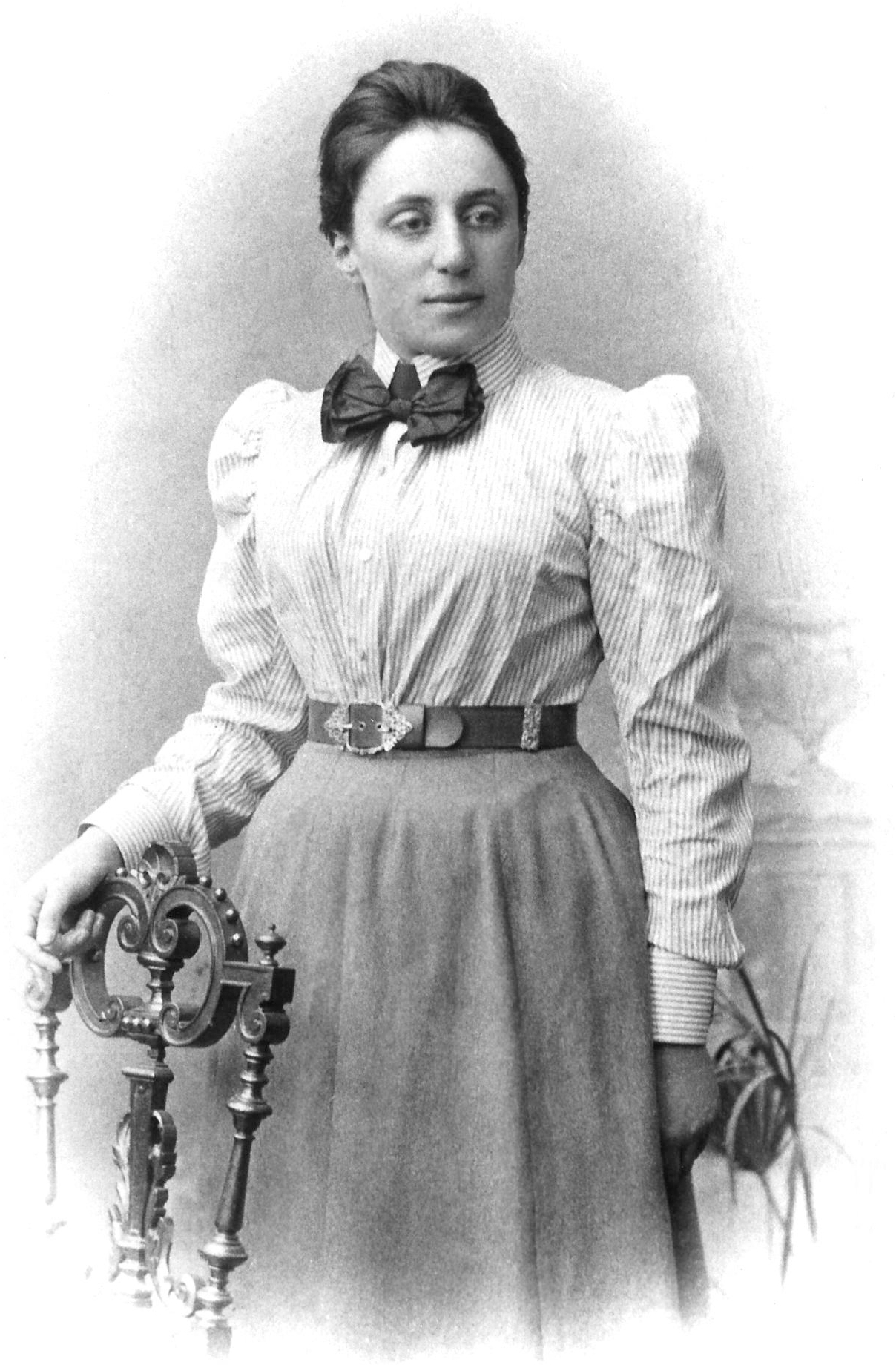
Emmy Noether (1882–1935) was a German mathematician whose ideas transformed modern algebra and gave mathematical physics one of its deepest connections.
Her career unfolded against barriers to women's access to academic life. At Göttingen, she initially taught under arrangements that reflected those restrictions, before obtaining her habilitation in 1919. The significance of her research would far outlast the institutions that resisted her.
Dismissed from her position in 1933 because she was Jewish, Noether left Germany and continued teaching and research at Bryn Mawr College in Pennsylvania, with regular visits to Princeton's Institute for Advanced Study. She died in 1935, at the age of 53.
A life of first principles.
Five moments in a history that changed the mathematical landscape.
- 1882ERLANGEN
A mathematician's beginning
Emmy Amalie Noether was born in Erlangen, Germany. She would go on to help reshape both modern algebra and mathematical physics.
- 1915GÖTTINGEN
A new intellectual centre
At the invitation of Felix Klein and David Hilbert, Noether joined the Göttingen mathematical community, despite institutional barriers facing women in academia.
- 1918MATHEMATICAL PHYSICS
Symmetry and conservation
Her paper Invariante Variationsprobleme established a far-reaching relationship between continuous symmetries of variational problems and conservation laws.
- 1921ABSTRACT ALGEBRA
Structure before examples
Her work on ideals and ascending chain conditions became foundational in the development of modern ring theory.
- 1933–35BRYN MAWR & PRINCETON
Ideas beyond borders
Dismissed from Göttingen under the Nazi regime, Noether continued research and teaching in the United States, including at Bryn Mawr and the Institute for Advanced Study.
The remarkable link between symmetry and what endures.
In her 1918 paper Invariante Variationsprobleme, Noether established that continuous symmetries of a suitable variational description of physical laws correspond to conservation laws.
In familiar examples, invariance under shifts in time is associated with energy conservation. Spatial translations are associated with linear momentum, and rotations with angular momentum. The precise result depends on the mathematical assumptions of the system.
These are ideas in theoretical physics—not a formula for forecasting financial markets.
Explore Noether's 1918 publication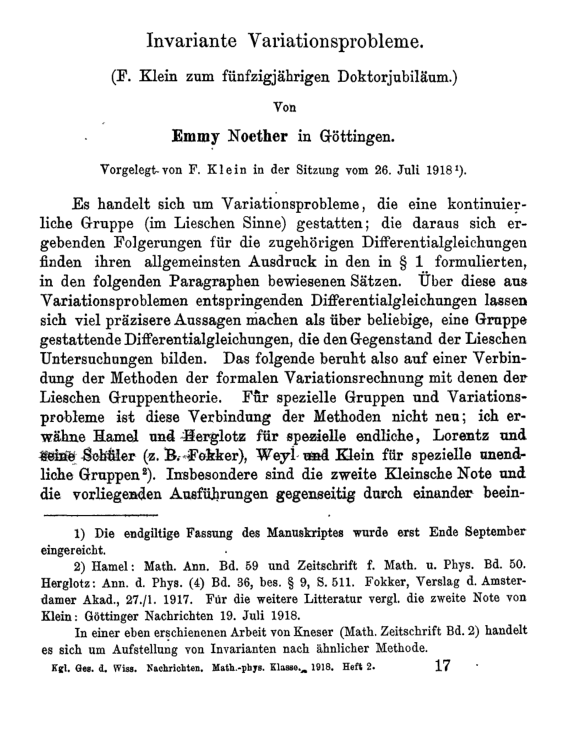
ARCHIVE / 1918 · GÖTTINGENOriginal publication scan, public domain ↗
Another revolution: abstract algebra.
Noether's influence extends far beyond physics. Her work on rings, ideals and structural conditions helped establish an abstract approach that continues to organise modern algebra.
Instead of treating isolated calculations as the end of an argument, her methods illuminated the relationships that made whole classes of problems intelligible. Mathematics became less about any single example and more about the structure shared across examples.
Why Noether.
Why Meridian.
A commitment to searching for the structures beneath the surface, to independent reasoning and to the discipline required to make an idea stand up to scrutiny.
A line of reference. Orientation without noise. Precision across borders. A symbolic reminder that good research needs both a rigorous foundation and a clear direction.
We chose a name that connects intellectual depth with the responsibility to make evidence useful.
Inspiration must become practice.
At Noether Meridian and through our Alpha Stochastic Research initiative, intellectual discipline is reflected in how hypotheses are framed, challenged and developed into reviewable quantitative work.
Formulate
State the hypothesis, its assumptions, and the observations that would count against it.
Examine
Work from traceable inputs and distinguish a convincing explanation from an attractive result.
Validate
Subject models, data and conclusions to independent scrutiny and reproducible tests.
Implement
Carry only reviewed ideas into controlled engineering, risk checks and documented delivery.
This is a statement of methodological aspiration, not a claim that Noether's theorem predicts asset prices or that our firm is affiliated with Emmy Noether, her family or the institutions cited here.
We honour Emmy Noether not by borrowing the authority of her discoveries, but by aspiring to the intellectual discipline that made them possible.
Selected historical sources.
This page draws on documented academic histories and primary material. The images are authentic historical material, not AI-generated representations.
Historic photograph (circa 1900–1910) and first page of the 1918 paper: Wikimedia Commons. Both files are marked public domain in their Commons source records. The photographs and manuscripts are used for historical illustration; their inclusion does not imply endorsement or institutional affiliation.